ENGR 101///Introduction to EngineeringBrian Jo, Kenneth Parker, Jeff Irlande
ENGR 101///SESSION 01
Brian Jo, Kenneth Parker, Jeff Irlande
Dimensions and units
This class will introduce students to dimensional analysis.
TODAY'S AGENDA
No sections found on this page yet.
Units and Dimensional Analysis
An engineer's superpower
The Mars Metric Mistake When starting out in STEM, units can feel like an administrative chore—extra labels you are forced to tack onto the end of a math problem. The reality is the exact opposite. Units are not an afterthought; they are the framework of reality. Learning how to manipulate them through dimensional analysis is one of the most powerful diagnostic tools you will ever acquire. Dimensional analysis can help you catch a wrong answer without actually knowing the answer. It can help you derive formulas that you've forgotten to memorize. And if you build a small prototype, dimensional analysis tells you if it will work as it should at full size.
So what's the main idea behind dimensional analysis? The main idea is that units can be treated like algebraic variables that must be the same on both sides of an equations.
If you are calculating the kinetic energy of a vehicle, your final units must resolve cleanly into Joules ( ). If you accidentally multiply velocity instead of squaring it, your units will catch your mistake long before a broken part does.
By mastering units and dimensional analysis, you stop being someone who blindly plugs numbers into formulas. You start developing the structural intuition necessary to look at a complex system and instantly spot whether a solution makes physical sense.
What are dimensions? What are units?
DIMENSIONSUNITS
Dimension is the type of physical quantity we are talking about (like mass, length, time, or current). A unit is how we measure it (like meters, kilograms, seconds, or amperes).
Fundamental dimensions
length, mass, and time
FUNDAMENTAL DIMENSIONS
There are 7 fundamental dimensions. The ones you will probably see and use most often are:
mass (M)
length or distance (L)
time (T)
current (I)
Other fundamental dimensions are temperature, amount of substance, luminous intensity.
Notation: We use square brackets "[" and "]" to indicate that we want the dimension for something. Some examples:
If is a variable representing the length of a soccer field, then .
If is a variable representing the mass of a car, then
Derived dimensions
Velocity, acceleration, force, energy
DERIVED DIMENSIONS
Everything else--e.g., speed, acceleration, force, or voltage--is a derived dimension, meaning it's just a combination of our fundamental dimensions.
Derived dimension
Dimensional formula
Notation
Area
Velocity (Speed): Distance (L) covered in a certain amount of time (T)
or
Acceleration: How quickly your velocity changes over time
or
Force: Newton's Second Law
Charge
Quiz//Question 1 OF 6
SCORE: 0
Q1. [Volume] = ?
Dimensionless quantities
DIMENSIONLESS QUANTITIES
What happens when you divide a length by a length? Or a mass by a mass? You get a "dimensionless" number. We use 1 to denote a dimensionless number.
is the ratio of a circle's circumference to its diameter, so .
The Mach Number (M) is the ratio of the speed of an object moving through a fluid to the speed of sound in that fluid, so [M] = 1.
An angle is measured as the ratio of an arc-length of a circle to its radius. If is the measure of some angle, then .
Are there other dimensions?
OTHER DIMENSIONS
How many people here have a bank account? What is stored in the bank account?
What about computer or phone memory? RAM?
While these might not be derived from the fundamental dimensions, you can define them as "pseudo"-dimensions, and treat them like any other dimension in dimensional analysis.
For example, in economics, money is often assigned its own dimension, designated as M. What are some examples of units of money? What would be an example of a conversion factor?
In information theory, information is often treated as a fundamental dimension H. What are some examples of units of information? Hint: It is something you pay attention to when you're buying a new computer or a new phone.
Units
UNITS
So we talked about dimensions, derived dimensions, and dimensionless quantities, but how do we actually measure some amount of these?
Units are specific quantities that represent an amount, or a magnitude, of the physical dimension.
Here are some common units:
S.I. (Système International d'Unités)
Imperial
Length
meter (m)
inch (in), foot (ft), yard (yd), mile (mi)
Mass
kilogram (kg)
ounce (oz), pound (lb), stone (st), Slug (slug)
Time
second (s)
second (s)
Current
Ampere (A)
Ampere (A)
Temperature
Kelvin (K)
Rankine (°R)
Unit conversions
Conversions
CONVERSIONS
In the S.I., you can create larger or smaller units by adding a prefix in front. Some common prefixes are below:
Prefix
Symbol
Factor
Example
kilo
k
1000 (thousand)
kg, or kilogram
mega
M
10^6 (million)
MB, or megabyte
giga
G
10^9 (billion)
GW, or gigawatt
milli
m
mA, or milliamp
micro
μ
μs, or microsecond
nano
n
nm, or nanometer
Quiz//Question 1 OF 4
SCORE: 0
Q1. How many watts (W) are in a milliwatt (mW)?
Attempts registered: 0
Here are some useful unit conversion ratios:
Length
Mass
Temperature
Let's take a look at this equation:
Quiz//Question 1 OF 2
SCORE: 0
Q1. [ hr] = ?
Let's divide both sides of the equation by 60 min: On the right hand side of the equation, the numerator and denominator cancel out, and we are left with:
Quiz//Question 1 OF 2
SCORE: 0
Q1. [ ] = ?
You can do the same thing with any units equation: so Sometimes we have a quantity with some units and want to convert it into some other units. We can do this with the railroad-track method. The idea is to multiply your quantity by 1 repeatedly. Let's go through an example: When you see the same units in the numerator and denominator, you can cancel them out. The right hand side becomes: Why do you think it is called the railroad-track method?
The Rules of Dimensional Homogeneity
RULES
Fourier's Principle of Dimensional Homogeneity: The universe operates under strict physical logic; you can never add or subtract variables that have different dimensions. When you add or subtract variables with the same dimensions, the result has that same dimension. So if you ever find yourself trying to add a Length to a Time, or a Mass to a Length, then you're doing something wrong.
Dimensional Balance: Every valid equation must balance perfectly on both sides. If the left side reduces to Length, the right side must reduce to Length. If the left side is a Force (remember that ), then the right side of the equation must also be a Force.
The Transcendental Rule: Certain functions need to have a dimensionless argument. We won't go over this rule in this class, but just including it here for future reference. It basically means there are certain functions, called "transcendental functions," including sine, cosine, exponential, and logarithms, that can only take dimensionless numbers as input.
These rules gives us some guidelines that physics must follow. They can help you to
Check whether an equation is valid
Derive formulas
Understand how the physics of a system will change as you scale up or down in size (For example, if you build a working 1/10-scale prototype of a drone, will it work the same way if you build it at full size?)
Checking whether an equation is valid
Case Study: Deconstructing Displacement
KINEMATICS
Here's an example from physics.
We can show the validity of the standard kinematics equation by breaking it down into fundamental dimensions where Length is L and Time is T:
Displacement ( ): Measured in meters (m). .
Initial Velocity Term ( ): Units are meters per second multiplied by seconds: . The seconds cancel out in the numerator and denominator, leaving .
Acceleration Term ( ): Units are meters per second squared multiplied by seconds squared: . The scalar is dimensionless. The time units cancel out, leaving .
Therefore, right-hand side of the equation, , has dimensions . Since each term has the dimension of Length, it is ok to add them together, according to Fourier's Principle of Dimensional Homogeneity. A Length plus a Length gives you a Length.
Since the left-hand side of the equation is a Length ( ) and the right-hand side is also a Length, then we can see the equation is dimensionally consistent by the Dimensional Balance rule.
Deriving formulas
Using Units as a Derivation Cheat Code
PROBLEM-SOLVINGMECHANICS
Reconstructing Centripetal Force ( )
Target Benchmark: Remember Newton's 2nd Law: . The dimensional form of this is . In S.I. units, force is measured in Newtons, defined as: .
Variables: Mass ( ), Velocity ( ), and Radius ( ).
Step-by-Step Logic:
To get mass ( ) on top, keep in the numerator.
To get seconds squared ( ) on the bottom, we can square velocity ( ). This gives us units of . So now we have
To eliminate the extra meter remaining on top, divide the expression by radius ( ).
Our final expression, , has units .
The Final Derived Formula: The dimensions balance and you didn't need to rely on memorization.
The Period of a Pendulum
[PLACEHOLDER]
Scaling arguments
Why can't an elephant grow much bigger?
PROBLEM-SOLVINGMECHANICS
Mass, and therefore weight, of an elephant is proportional to its volume, which has dimensions .
However, the strength of its legs depends on the cross-sectional area, which has dimensions .
As we scale the size of the elephant up, the weight eventually overcomes the strength of the legs.
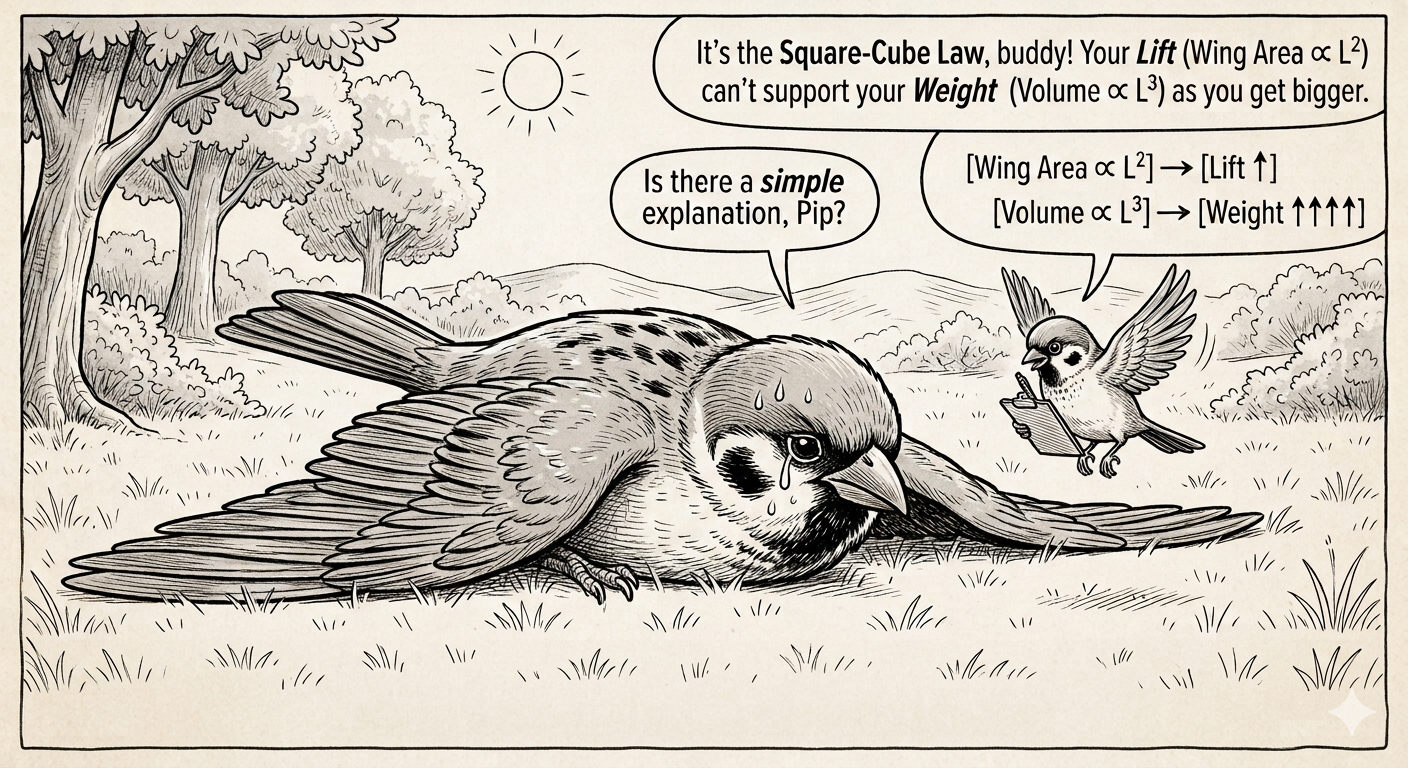
The same argument applies to birds. The lift generated by a bird's wings is proportional to its area, which has dimensions . However, the bird's weight, just like the elephant's, is proportional to its volume, which has dimensions . As the bird gets larger (assuming its proportions don't change), its weight grows faster than the lift generated by its wings. Sparrows don't scale
Units and quantities in day-to-day life
BENCHMARKING REALITY
Many practicing engineers, physicists, and machinists do not just calculate answers; they have a physical feel for the quantities encountered in real-world problems. This deeply ingrained intuition acts as an instant sanity check whenever they are building a prototype, writing a simulation, or troubleshooting a failure. The following sections have some typical quantities that are useful to know and memorize as a reference if you are planning to continue in STEM. Try to get to know the world around you in terms of numbers and measurable quantities, and you will gradually build up your own physical intuition.
Consider how a seasoned professional approaches a design problem. They do not start with abstract equations; they start with known, real-world benchmarks:
The Battery Check: Knowing that a typical alkaline AA battery provides around 1.5V and safely delivers 100–500 mA under a medium load gives an engineer an instant, rough sense of how many cells are required to drive a specific circuit before they ever touch a calculator. Not enough batteries
The Machinist's Feel: A machinist knows that a heavy steel component shouldn't deflect by more than a few micrometers under tool pressure. If a formula spits out an answer in millimeters, their intuition flags a catastrophic design flaw immediately.
The Thermal Reality: A thermal engineer knows a small cooling fan moves roughly 10–50 CFM (cubic feet per minute) of air. If their math says they need 5,000 CFM to cool a laptop, they know they used the wrong equation.
Human Electrical Lethality
SAFETYELECTRICITY
When evaluating electrical safety, remember: Current kills, but voltage forces it through. The human body's dry skin has a resistance of roughly 10,000 to 100,000 Ω, but wet or broken skin drops that resistance down to about 500 to 1,000 Ω.
1 mA: Threshold of human perception; produces a faint tingling sensation.
6-10 mA: The "Let-Go" threshold. Involuntary muscle contractions. You may be unable to release a live wire.
50-100 mA: Triggers ventricular fibrillation and respiratory paralysis; typically fatal within seconds.
50 V: Universal regulatory safety cutoff where voltage overcomes dry skin resistance to drive lethal current.
Thermodynamics & Household Power
THERMODYNAMICSENERGY
1,500 W: Standard power ceiling for high-draw appliances to avoid tripping 15A household circuit breakers. Because standard US outlets top out around 15 Amps at 120 Volts ( ), manufacturers design high-draw appliances right at 1,500 W to avoid tripping standard circuit breakers.
toaster: ~1,500 W
microwave oven: ~1000 W
computer: ~130 W
52-in LED TV: ~100 W
4.18 Joules: Specific heat capacity required to raise the temperature of 1 gram of water by 1°C. This means a 1,000W electric kettle will take roughly 4.2 seconds to heat a tiny shot of espresso water by 1°C, allowing you to estimate heating time.
37°C (98.6°F): Normal human core body temperature. Knowing that room temperature is typically 20°C to 22°C (68°F - 72°F) reminds you that your body is constantly radiating heat into its environment to dump metabolic waste heat.
21°C (70°F): Average comfortable room temperature used as a standard ambient baseline in thermal equations.
Mechanical & Civil Scale Baselines
PHYSICSMECHANICS
100 kPa (14.7 psi): Ambient atmospheric air pressure exerted at sea level under standard conditions. This is approximately the air pressure around us right now.
2,000 kg: Average mass of a modern consumer SUV.
9.81 m/s²: Approximate acceleration due to gravity on the earth's surface, used to quickly convert mass into Newtons of force.
1,000 kg/m³: Volumetric density of pure water, equating exactly to one metric ton per cubic meter.
Data & Electrical Infrastructure
DATAINFRASTRUCTURE
100 ms: Maximum human perception latency threshold for an interaction to feel completely instantaneous.
25 Mbps: Minimum sustained internet download bandwidth required to stream uncompressed 4K video.
12 Wh: Typical energy capacity of a standard smartphone battery.
75,000 Wh: Average energy capacity of an electric vehicle battery pack.
SYSTEM VIEW ENGINE//Astronomical Length Scales
Drag the master slider to sweep across orders of magnitude and filter matching physical boundaries.
10^6 meters (1,000 km)
10^310^12
Display Unit Framework:
Mean Radius of Earth 🎯 In Range6,371 km
Equatorial baseline radius from core to crust.
Relative Scale: 10^6.8
One Light-Second Travel Universal Limit3.00e+5 km
The absolute distance light travels through a vacuum in a single second.
Relative Scale: 10^8.5
Distance to Moon Orbit 3.84e+5 km
Average traversal gap spacing between planetary bodies.
Relative Scale: 10^8.6
Mean Earth-Sun Distance 1.50e+8 km
Crucial reference metric standard denoting 1.0 AU.
Relative Scale: 10^11.2
Quiz//Question 1 OF 17
SCORE: 0
Q1. How many feet long is a football field?
The Buckingham Pi Theorem
BUCKHINGHAM PI
This topic is somewhat beyond the scope of this class. To really understand the Buckingham Pi Theorem, you need to learn some linear algebra first. But here is the basic idea.
The Buckingham Pi Theorem is a shortcut used by scientists and engineers to simplify complex math problems by grouping variables together. Imagine you want to design a new rocket, and you need to figure out how air resistance affects its speed. You might have a massive list of variables to test: the rocket's length, its weight, the air density, and its speed. Testing every single combination in a wind tunnel would take years.
The Buckingham Pi theorem lets you can combine those individual variables into a smaller set of variables called dimensionless groups (or Pi groups).
How It Works:
Find the variables: List everything affecting your problem (e.g., speed, size, density).
Count the units: Count the fundamental units involved (like Mass, Length, and Time).
Subtract to simplify: Subtract the number of units from the number of variables.
The answer tells you exactly how many dimensionless groups you need to test.