ENGR 101///Introduction to EngineeringBrian Jo, Kenneth Parker, Jeff Irlande
ENGR 101///SESSION 03
Brian Jo, Kenneth Parker, Jeff Irlande
Basic mechanics
This class introduces the language of mechanics: position, velocity,
acceleration, vectors, forces, momentum, work, and energy. Students will
use Newton's Laws to build simple mathematical models of physical systems
and will see that the same physical situation can often be analyzed in
several different ways.
TODAY'S AGENDA
No sections found on this page yet.
Newtonian physics
What is motion?
WHAT IS MOTION
Mechanics is the study of how objects move and what causes their motion to change. It is one of the oldest areas of physics, but it is also the foundation for engineering, robotics, aerospace, biomechanics, and much of modern technology.
Steampunk observatory The important question is not simply "How does something move?" but:
A useful first distinction is between kinematics and dynamics.
Kinematics: describes motion without asking what causes it.
Dynamics: explains changes in motion using forces and
interactions.
Basic trigonometry
SINECOSINE
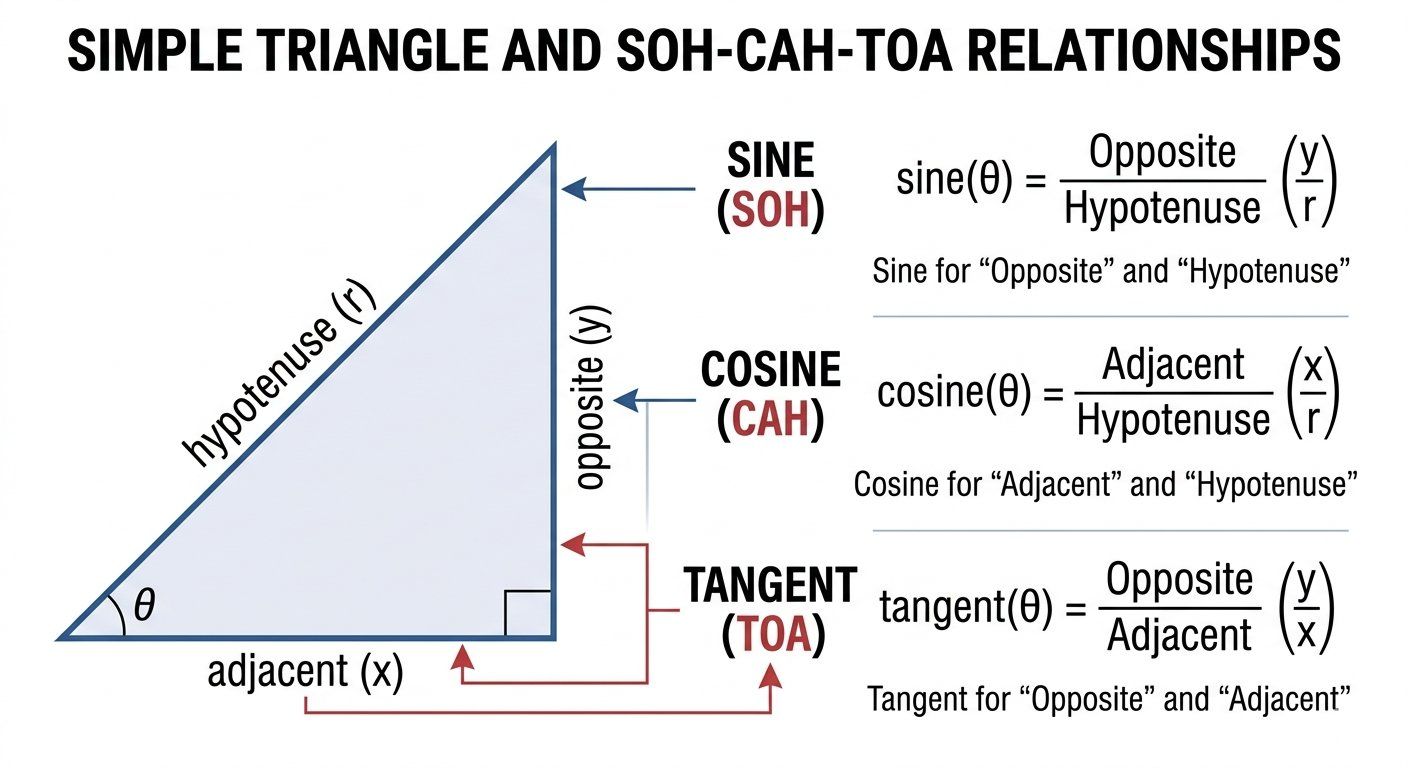
If you haven't taken trigonometry and don't know what , , and mean, it will be useful to go over the definitions, since we will need these functions later in this class. The basic idea is actually pretty straightforward:
is the ratio of the length of the side opposite the angle to the length of the hypotenuse in a right triangle. For example, referring to the image below, we have:
is the ratio of the length of the side (not the hypotenuse) adjacent to the angle to the length of the hypotenuse:
is the ratio of the length of the side opposite the angle to the side (not the hypotenuse) adjacent:
SOH-CAH-TOA As you can see in the image above, there is a simple mnemonic--"SOH-CAH-TOA"--that people use to remember the ratios for , , and .
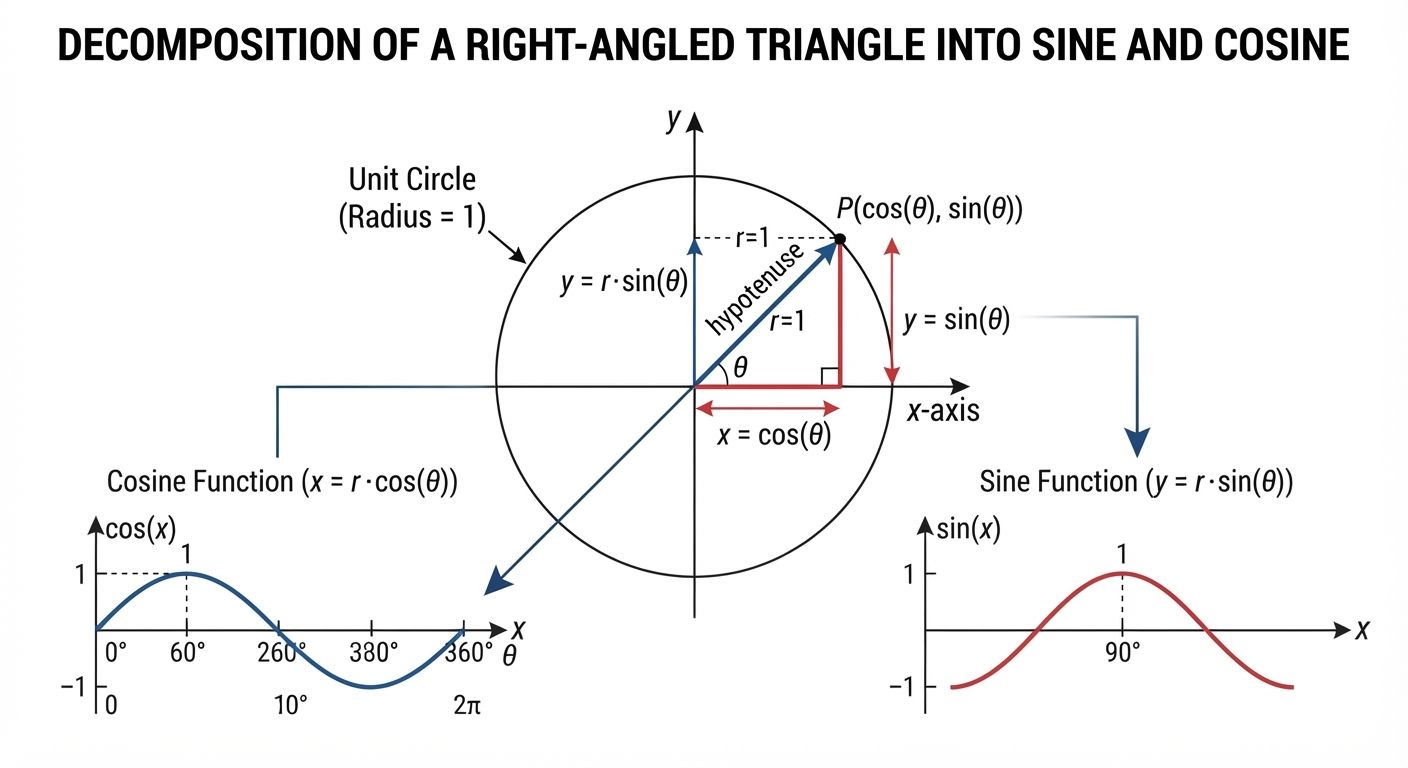
If the hypotenuse , then "SOH" and "CAH" tells us that and . In other words, if you draw a circle with radius and pick any point on this circle, and will give you the and coordinates of the point:
Graphs of sin and cos
Scalars and Vectors
Magnitude and direction
SCALARSVECTORS
A vector is a quantity that has both a magnitude and a direction. Displacement, velocity, acceleration, and force are all vectors. A useful mental model is to think of a vector as an arrow. The length of the arrow is its magnitude; the arrowhead gives the direction. A vector is a geometric object, just like a line, line segment, ray, or point. To show that a quantity is a vector, we use a special notation: a small arrow above the variable. For example, is a vector.
Scalars have magnitude but no direction. Time, mass, temperature, and
energy are examples of scalars. A scalar is just a fancy name for a number.
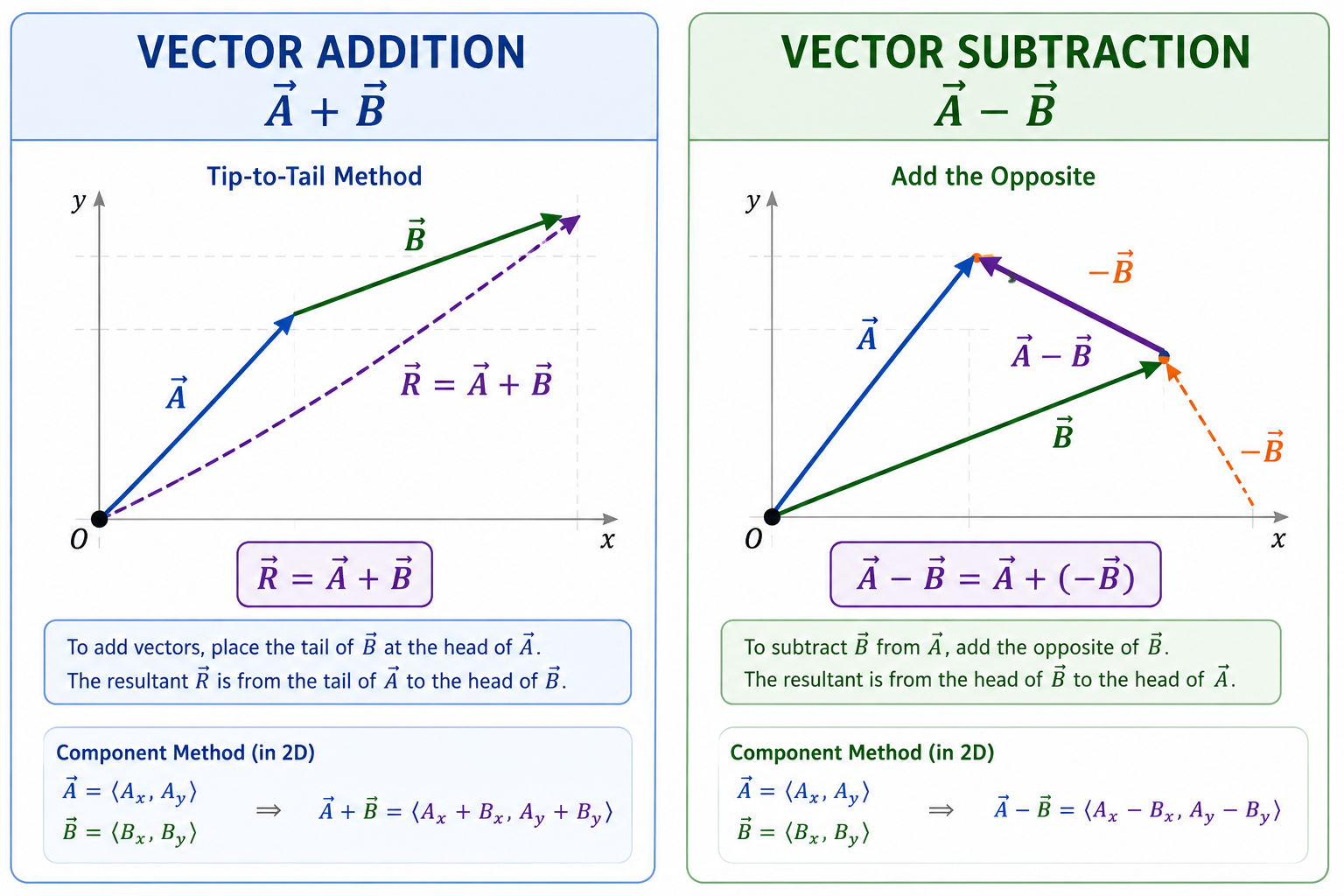
Vector addition means placing one vector after another. The sum of vectors is called the resultant. Subtraction is equivalent to adding the vector pointing in the opposite
direction. The resultant of 2 vectors You can multiply a vector by a scalar : For example, will give you the same result as adding to itself. Multiplying a vector by a positive scalar changes the vector's magnitude without changing its direction. Multiplying by a negative scalar changes the vector's magnitude and reverses its direction.
There is a special vector, called the zero vector: . This is what you would get if you multiplied a vector by the scalar number 0: or if you subtracted a vector from itself: A set of vectors is called linearly dependent if there's a way to multiply them by scalars and then add them up to get back the zero vector, where at least one of the scalars must be non-zero. In math, this looks like: If a set of vectors is not linearly dependent, then it is linearly independent.
Can you multiply vectors together? Multiplying magnitudes might be straightforward, but how would you deal with different directions? There is, in fact, an operation called a dot product that is like multiplication, except with vectors:
The dot product tells us how much one vector points in the direction of another vector. If you review the section on trigonometry, you can see that
when
when
when
So the more that the vectors point in the same direction, the bigger the dot product gets.
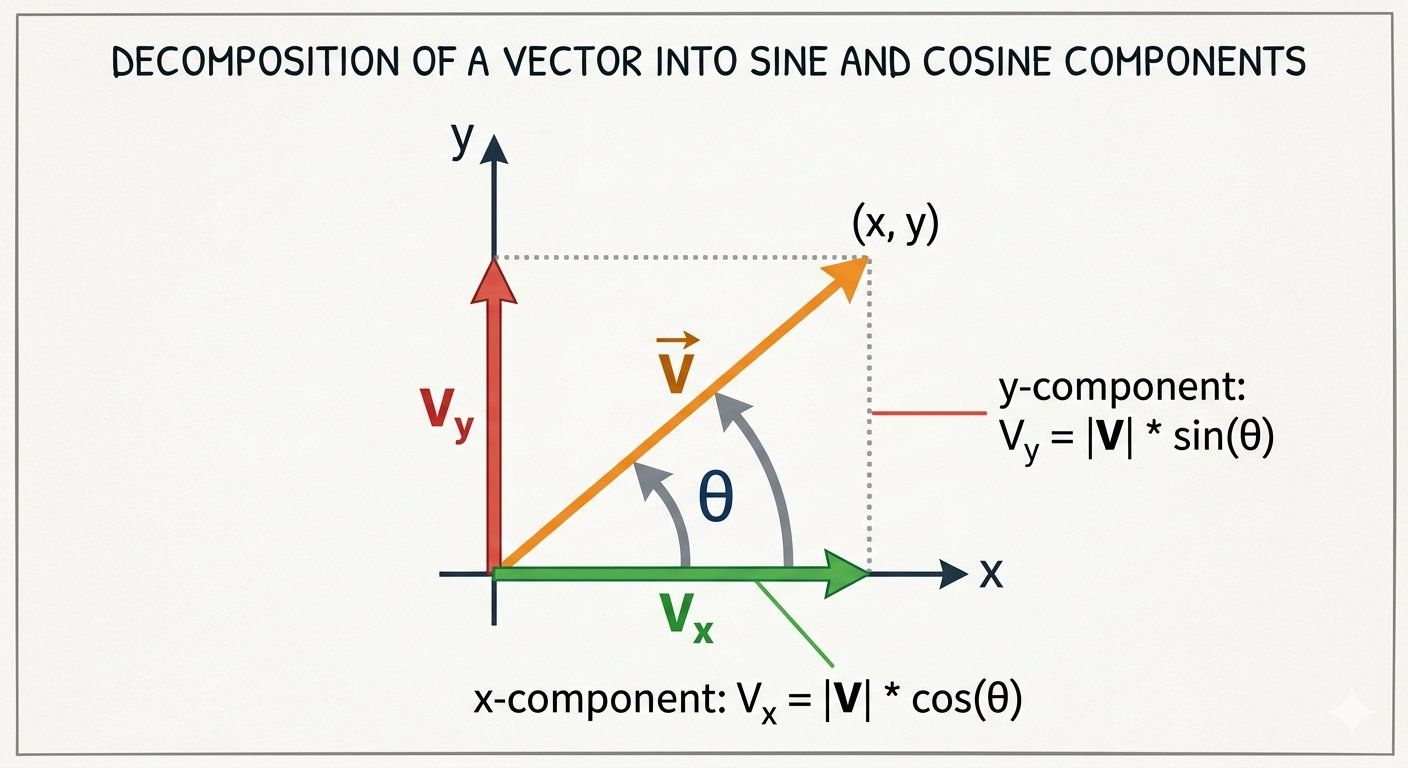
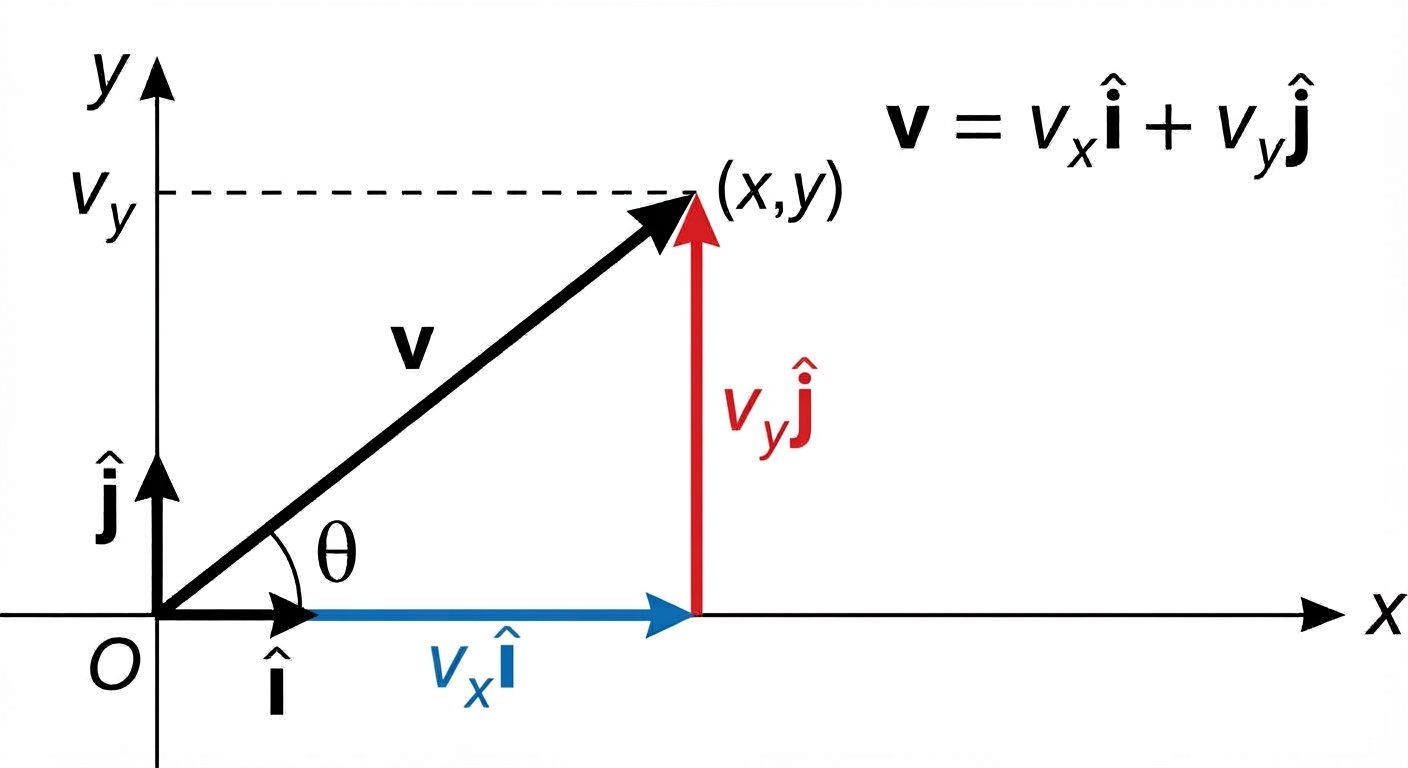
Finally, observe that vectors can be broken into perpendicular components. For a vector with
magnitude at angle :
How a vector can be decomposed into its sine component and cosine component
Coordinate systems
COORDINATES
Before describing motion, we need a way to describe a location. We do this by defining a coordinate system. A coordinate system consists of:
a reference point called the origin ( ), and
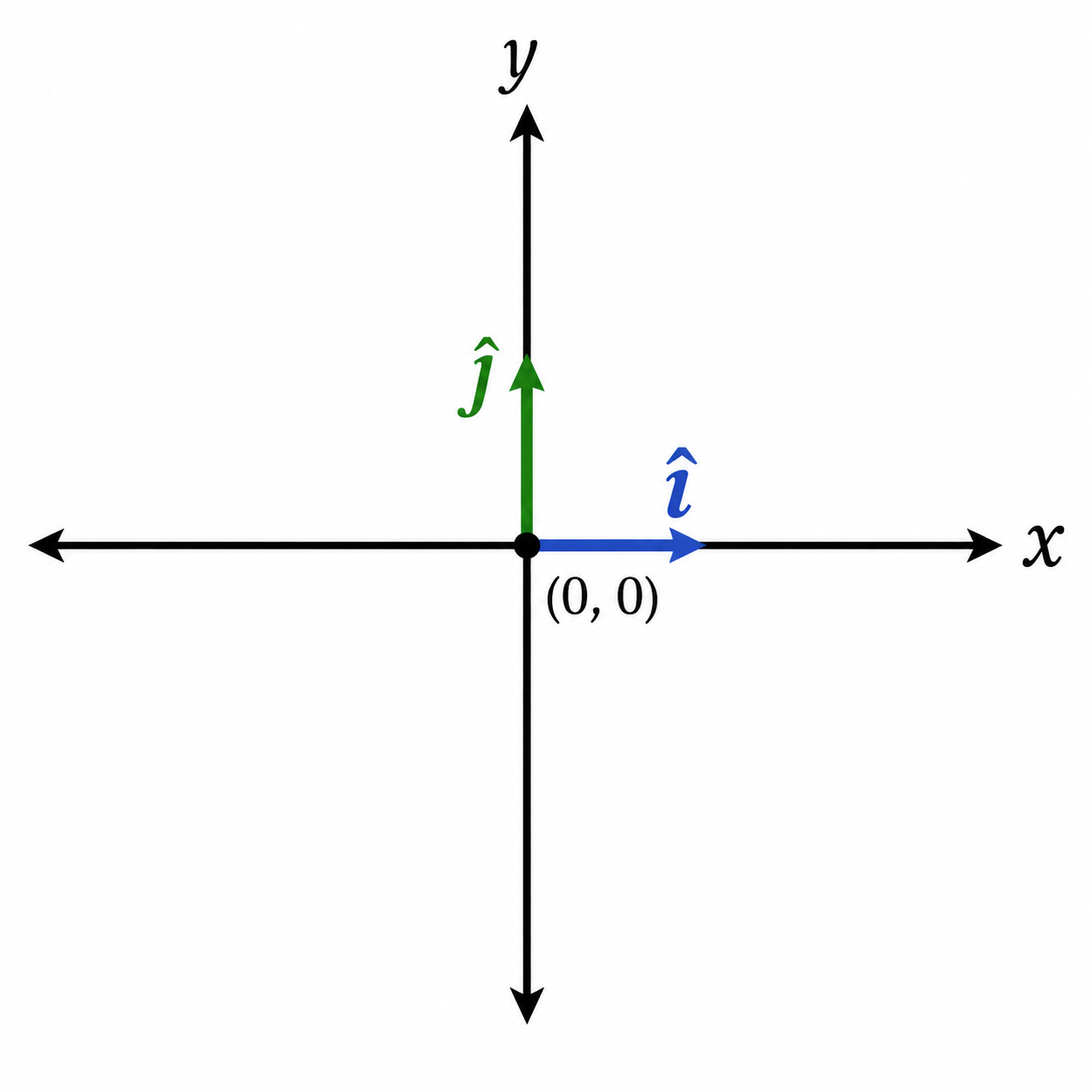
a set of vectors that specify the axes and a unit length along each axis, also known as a basis. The basis must be linearly independent. A common notation for the vectors that make up the basis of a coordinate system are to write them with a "hat" symbol on top: . The number of basis vectors is called the dimension of the space (e.g., "1D", "2D", "3D").
Oftentimes, the vectors in the basis are chosen to be perpendicular to each other, or orthogonal. For example, you might be familiar with a typical 2D coordinate system consisting of an x-axis and a y-axis. The two basis vectors here both have a magnitude of 1, so they are referred to as unit vectors. One points in the direction of the positive x-axis, and the other points in the direction of the positive y-axis. The basis vectors give us the scale along different axes. Each basis vector tells us the size of 1 unit along its axis, so you can think of it as a 1-unit tick mark along a ruler.
2D coordinate system
Solving vector equations
VECTOR EQUATIONS
Once we have a coordinate system, we can represent vectors with coordinates. The idea is that we can break up any vector into a sum of basis vectors. For example, in a typical 2D Cartesian coordinate system with basis vectors , we have: Vector decomposed into basis vectors along x- and y-directions In practice, we usually write this as: where and are the vector's coefficients of and , or, equivalently, its components along the x- and y-axis. For example, means "3 units in the x direction and 4 units in the y direction." We can then use the Pythagorean Theorem to calculate its magnitude: Once vectors are written in coordinates, addition and subtraction become remarkably simple: operate on corresponding components. For example, if we have and ,
then Similarly, This is the coordinate version of the geometric head-to-tail rule that we covered earlier. The coordinate version of scalar multiplication is to multiply each component by the scalar:
In 3D, every vector has 3 components: All the operations above are essentially the same, except with 3 components instead of 2.
Coordinates turn geometric vector operations into ordinary arithmetic. Instead of manipulating arrows directly, we can manipulate their components—and let the mathematics keep track of the geometry for us.
There is another very useful relationship when we use coordinates. Remember how we discussed the idea of "multiplying" two vectors together using the dot product? Let's represent each vector as a sum of basis vectors: The distributive law works with dot products of vectors in the same way that it does when you're multiplying scalars: Remember that the dot product is the product of the magnitudes of two vectors by the cosine of the angle between them. Since and are unit vectors, their magnitudes are both 1. The angle between and itself is 0°, while the angle between and is 90°.
Therefore, and the dot product simplifies to: In other words, once you have each vector in component form, all you need to do to get the dot product is multiply the components together pairwise, and then add them all up at the end. This also works in three dimensions, four dimensions, or even a million dimensions.
Kinematics in 1D when acceleration is constant
Let's pause our discussion of vectors and coordinate systems to discuss kinematics in 1D.
Imagine an object moving along a straight line. At some initial time, the object is at position and has velocity . The object is accelerating at some constant acceleration .
Before we introduce the kinematic equations, it is important to understand what velocity and acceleration actually mean. Both are rates of change: they tell us how quickly one physical quantity is changing compared with another.
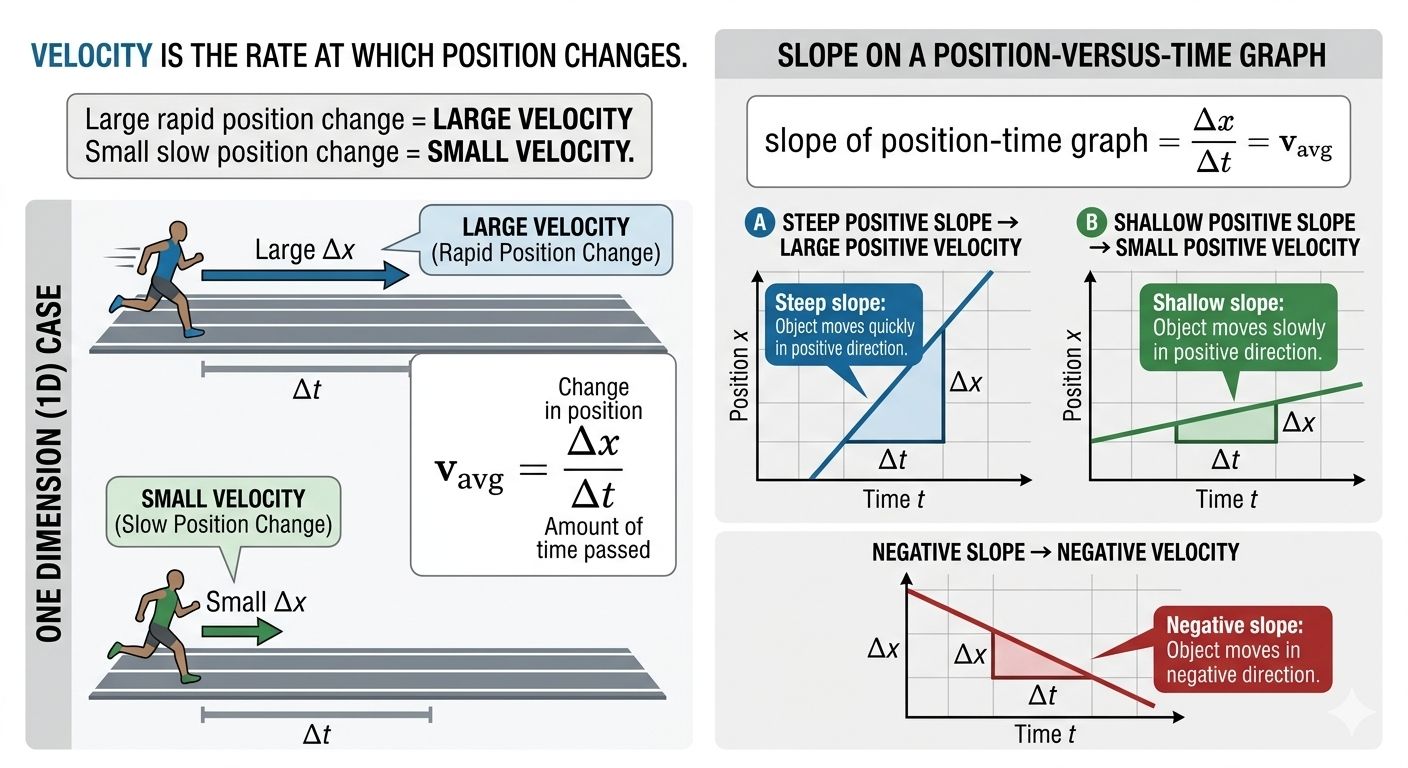
Velocity is the rate at which position changes.
If an object's position changes rapidly, it has a large velocity. If its position changes slowly, it has a small velocity. In one dimension, we can write the average velocity as where is the change in position and is the amount of time that passes.
This is the same idea as slope. On a position-versus-time graph, position is on the vertical axis and time is on the horizontal axis, so
So the slope of a position-time graph tells us the object's velocity. A steep positive slope means the object is moving quickly in the positive direction. A shallow positive slope means it is moving slowly in the positive direction. A negative slope means the object is moving in the negative direction.
Illustrating average velocity For an instant in time, we can make the time interval smaller and smaller. The instantaneous velocity is the slope of the position-time graph at that particular instant. We say that the instantaneous velocity is the "derivative of position with respect to time." In mathematical notation, it looks like this:
Acceleration is the rate at which velocity changes.
An object can have a velocity that is changing even if it is moving along a perfectly straight line. For example, a car might be traveling at and then increase its velocity to over a few seconds. The car is accelerating because its velocity is changing.
Average acceleration is defined as Again, this is a slope. On a velocity-versus-time graph, velocity is on the vertical axis and time is on the horizontal axis. Therefore, So the slope of a velocity-time graph tells us the object's acceleration.
If the velocity-time graph slopes upward, velocity is increasing and the acceleration is positive. If it slopes downward, velocity is decreasing and the acceleration is negative. If the velocity-time graph is horizontal, velocity is constant and the acceleration is zero.
The instantaneous acceleration is the slope of the velocity-time graph at a particular instant: This gives us a useful chain of ideas:
Position tells us where the object is. Velocity tells us how quickly position is changing. Acceleration tells us how quickly velocity is changing.
Or, thinking entirely in terms of graphs:
The slope of position gives velocity. The slope of velocity gives acceleration.
There is also an important connection in the other direction. If we know velocity over a period of time, the area under a velocity-time graph tells us the change in position: Likewise, the area under an acceleration-time graph tells us the change in velocity: So we can move through the three graphs in either direction:
Differentiate: position → velocity → acceleration Integrate: acceleration → velocity → position
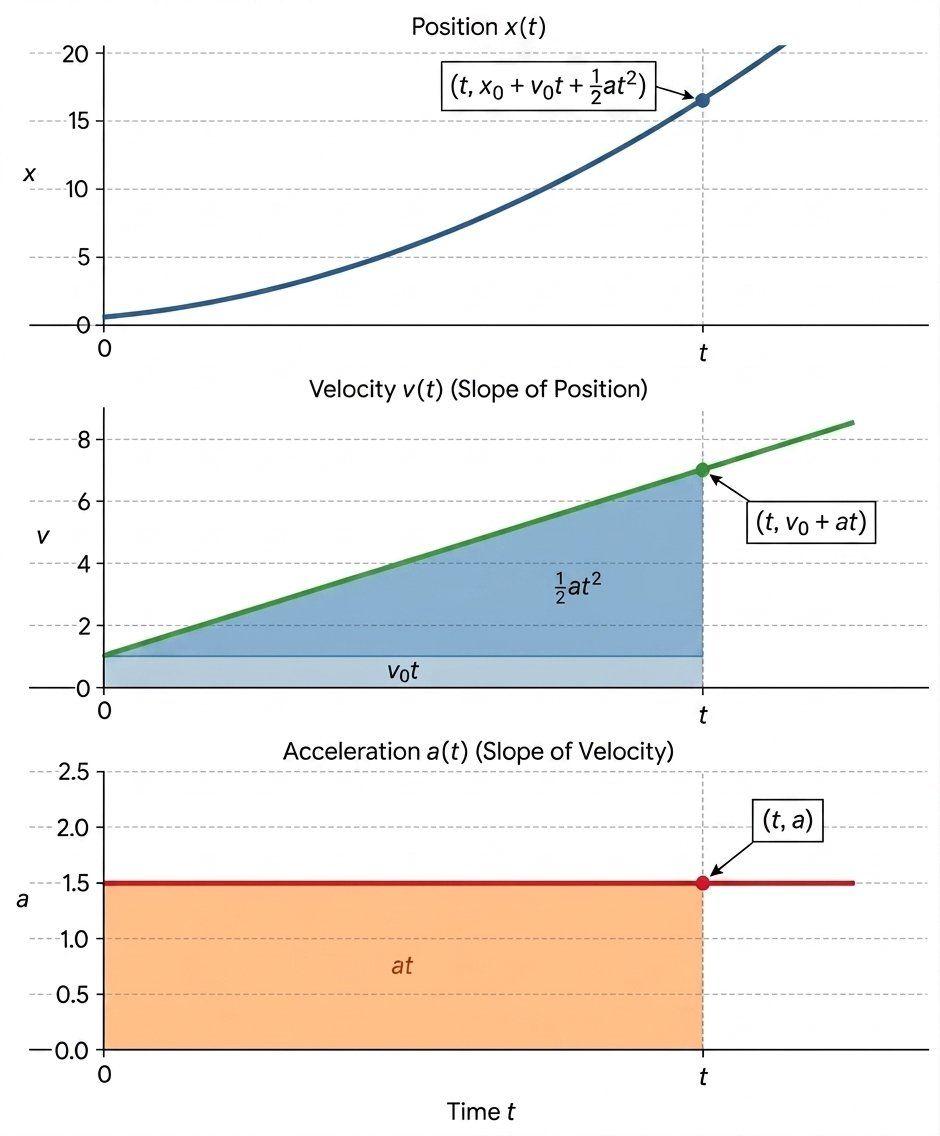
For the special case where acceleration is constant, these relationships become especially simple. The velocity changes by the same amount during every equal interval of time. Therefore, the velocity-time graph is a straight line, and the position-time graph is a parabola.
We can see all of these relationships together in the three graphs below:
Position, velocity, and acceleration for one-dimensional motion with constant acceleration Starting with an initial velocity and constant acceleration , the velocity after time is The displacement during that time is And we can eliminate time to obtain another useful relationship: These are the kinematic equations for one-dimensional motion with constant acceleration. They are the mathematical consequences of the same basic ideas: velocity is the rate of change of position, and acceleration is the rate of change of velocity.
Kinematics in multiple dimensions
KINEMATICS2D3D
So far, we have restricted ourselves to motion along a single straight line. That restriction allowed us to describe position, velocity, and acceleration using a single number, such as , , or . But objects in the real world rarely move only left and right. A baseball can move upward and forward, a spacecraft can change direction, and a car can follow a curved road. To describe motion in two or three dimensions, we need to keep track of direction as well as magnitude. This is exactly what vectors allow us to do. The good news is that the fundamental ideas do not change: velocity is still the rate of change of position, and acceleration is still the rate of change of velocity. We simply replace our one-dimensional quantities with vectors: position becomes the position vector , displacement becomes , velocity becomes the velocity vector , and acceleration becomes the acceleration vector .
Position and displacement
Where are you?
POSITIONDISPLACEMENTDISTANCE
Position (denoted by ) is a vector describing a location relative to the origin of the coordinate system.
Distance ( ) is a scalar quantity representing the total length of the path traveled ( ).
Displacement ( ) is a vector quantity representing the net change in position. It is equal to your final position minus your starting position, or
Quiz//Question 1 OF 3
SCORE: 0
Q1. You walk 3 m east and then 3 m west. What is your total distance in meters?
This distinction becomes extremely important once we begin working with
velocity and acceleration.
Velocity
How fast and which way?
VELOCITYSPEED
Average velocity is a vector that describes how rapidly position changes. It is represented by displacement divided by change in time:
Average speed is a scalar that uses total distance traveled: A car can have a large speed while having zero average velocity—for
example, if it drives around a track and finishes exactly where it began.
The instantaneous velocity is a vector that represents the velocity at one particular instant. Just like we did in the 1D case, we are taking the derivative of the position with respect to time. In mathematical notation, it looks like this:
When we discussed the derivative in the 1D case, we said it was the slope of the position with respect to time. But what is the derivative of the position vector? How do you take the slope of a vector?
Well, you can't really take the slope of a vector. But with a coordinate system, you can take the slopes of the individual components of the vector. So the instantaneous velocity (a.k.a. the derivative of ) becomes: So everything we discussed in the 1D case applies here too! You just need to consider each coordinate separately. The represents how the magnitude and direction of changes with respect to time.
Acceleration
When velocity changes
ACCELERATION
Acceleration measures how rapidly velocity changes with time. Notice that velocity is a vector, so an object accelerates whenever its velocity changes in magnitude or direction.
Yes. Its speed is constant, but its direction is continuously changing.
Demonstration — Swinging object: Swing a ball attached to a string in a circle so that its speed remains approximately constant. Is the ball accelerating?
Near Earth's surface, ignoring air resistance, the acceleration due to gravity is approximately:
Center of mass
When we analyze the motion of an object, we often pretend that the entire object is concentrated at a single point. But where should that point be?
That point is the center of mass: the weighted average position of all the mass in an object.
For a collection of point masses, Think of it as a balance point. If you could somehow place a support directly underneath the center of mass, the object would balance.
Why is this important? The center of mass lets us treat a complicated object—or even a collection of objects—as though all of its mass were concentrated at one location. This idea will be critical when we start talking about external forces and Newton's second law of motion. For example, imagine a student standing on a frictionless skateboard. If the student walks toward the front, he or she moves forward, but the skateboard moves backward. There is no external horizontal force, so the center of mass of the student + skateboard system does not accelerate. The individual pieces can move in complicated ways while the center of mass follows a much simpler path.
The evolution of theories of motion
From Aristotle to Einstein
HISTORY OF MECHANICS
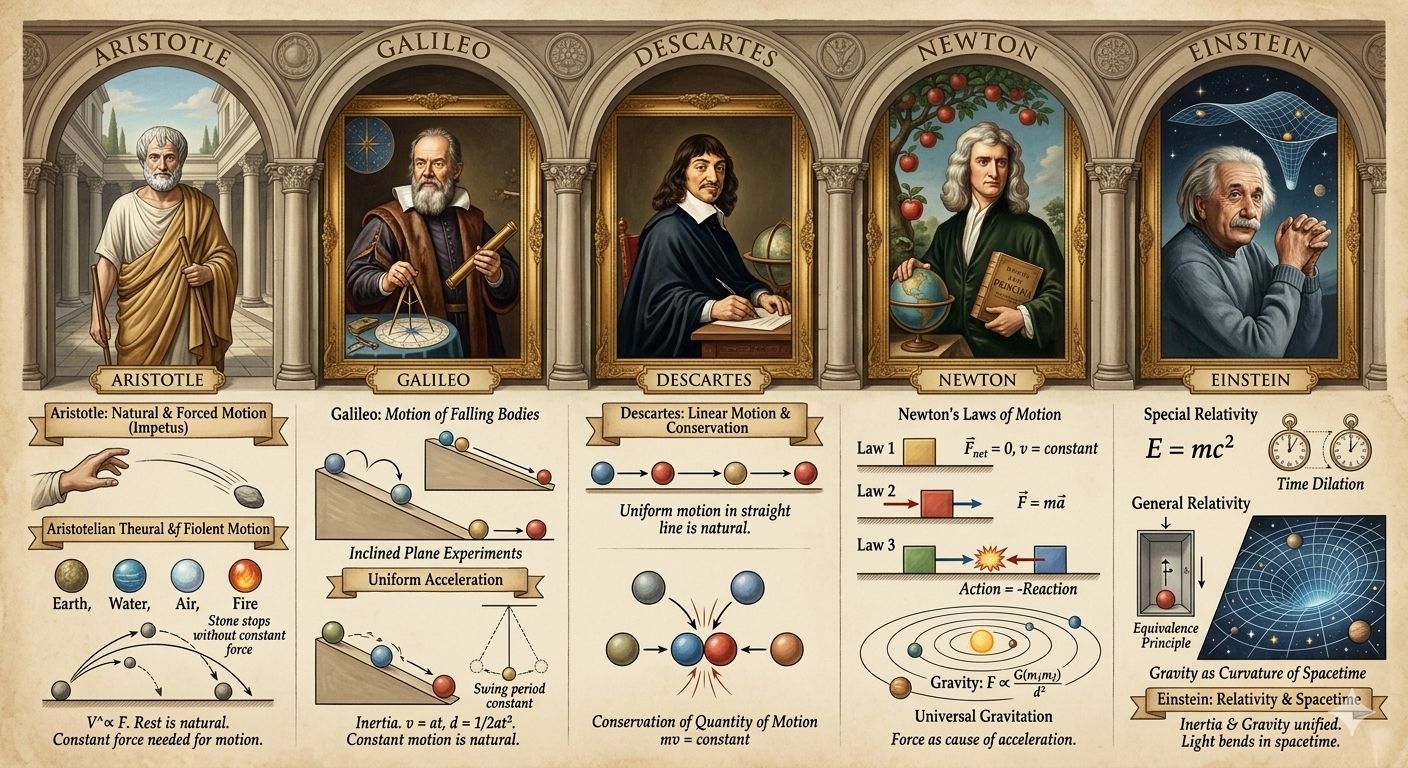
Our modern understanding of motion did not appear all at once. It developed over centuries as scientists challenged intuitive ideas, performed experiments, and built increasingly powerful mathematical theories.
Aristotle: Aristotle argued that an object's natural state was to be at rest. He believed that continued motion required a continuing force. These ideas seemed reasonable because, in everyday life, objects eventually stop moving due to friction.
Galileo: Galileo challenged Aristotle by recognizing the importance of friction. He imagined what would happen if friction could be gradually reduced. A moving object would travel farther and farther before stopping—and in the ideal case of no friction, it would continue moving indefinitely. Galileo's conception of this motion was not yet exactly the Newtonian idea of straight-line inertia. In his thought experiments, he considered objects moving along the curved surface of the Earth. The important breakthrough was that continued motion does not require a continuing force.
Descartes: René Descartes took the idea of inertia closer to the modern concept. He argued that a body in motion would continue moving in a straight line unless something caused it to change direction or speed. This was an important conceptual step: motion did not naturally require a force to sustain it; rather, forces were associated with changes in motion.
Newton: Newton built on these ideas and turned them into a precise mathematical theory. His First Law states that, in the absence of a net external force, an object maintains a constant velocity: Newton's Second Law then explains how a net force changes that velocity: Newton's laws provided a framework that could predict the motion of objects ranging from falling stones to orbiting planets.
Einstein: Einstein showed that Newton's mechanics is not the final word. At ordinary speeds and scales, Newton's laws work extraordinarily well. But when objects move close to the speed of light, or when gravity becomes extremely strong, relativity is required. Einstein showed that space and time are not absolute and that gravity is connected to the geometry of spacetime.
The evolution of motion The progression is therefore a story of increasingly general ideas:
Aristotle: Motion requires a force.
Galileo: Motion can continue indefinitely without a force.
Descartes: Free motion continues in a straight line.
Newton: Force changes velocity; without a net force, velocity remains constant.
Einstein: Newton's laws are an extremely successful approximation within a broader theory of space, time, and gravity.
Newton's first law
Inertia
FIRST LAW OF MOTION
Newton's First Law says that an object maintains its velocity unless a net external force acts on it.
Notice that this does not mean the object must be stationary. It can remain at rest, or it can continue moving with constant velocity.
The tendency of an object to resist changes in its velocity is called inertia. An object with inertia tends to keep doing what it is already doing: if it is at rest, it tends to remain at rest; if it is moving, it tends to keep moving at the same velocity.
Inertia is not a force. It is a property of matter. The more massive an object is, the greater its inertia, which means the harder it is to change its velocity. This is why it takes much more force to accelerate a truck than a bicycle by the same amount.
Newton's First Law can therefore be thought of as a statement about inertia: objects resist changes in their motion. A net external force is what produces that change.
This law also defines the idea of an inertial reference frame: a reference frame in which an object with no net force moves at constant velocity.
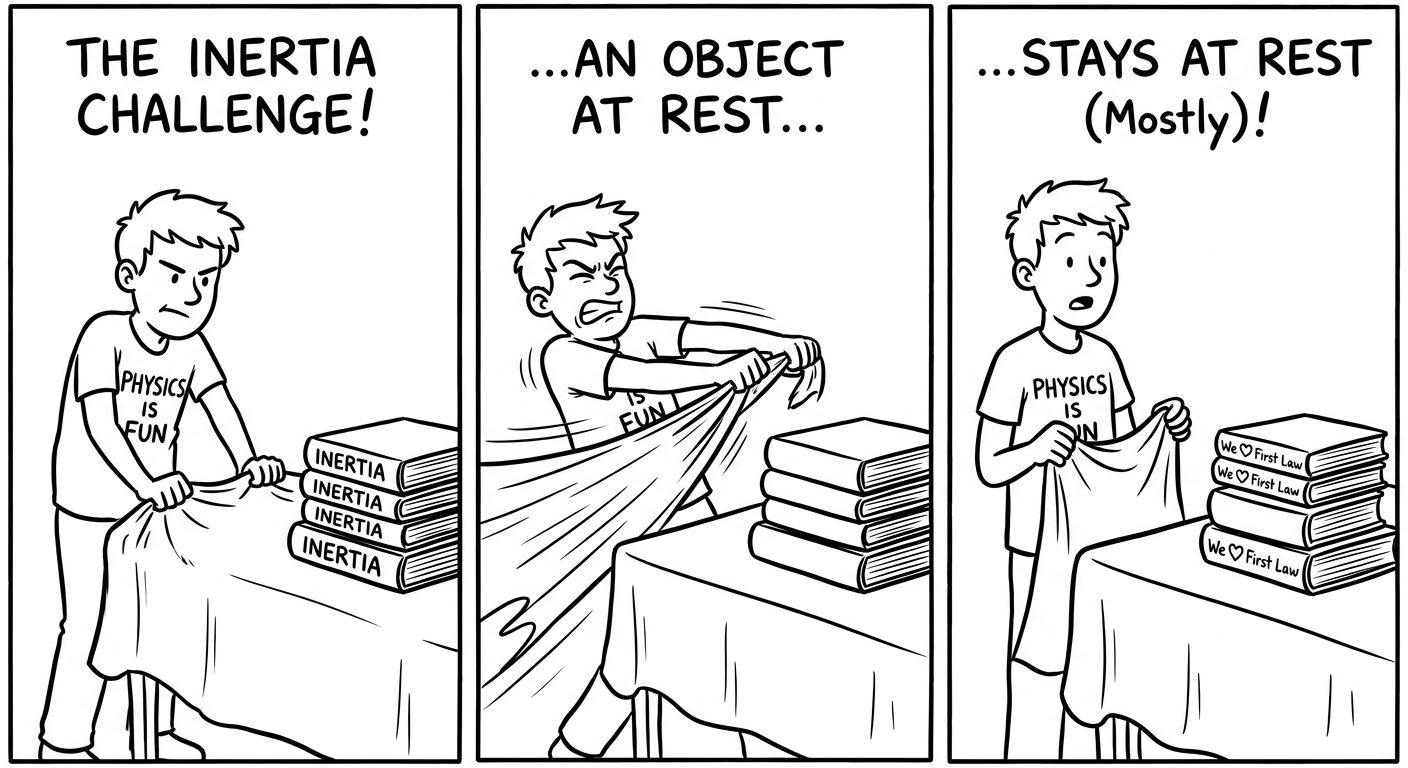
Demonstration — Tablecloth trick: Place a smooth object on a sheet of paper and pull the paper quickly. The object tends to remain near its original position because its inertia resists the sudden change in its motion. Tablecloth trick Demonstration — Coin and card: Place a coin on a card over a cup. Flick the card horizontally and observe the coin's motion. The card moves out from underneath the coin, while the coin tends to remain at rest. Gravity then causes it to fall into the cup.
You are not actually being pushed backward by a mysterious force. Your body tends to maintain its previous velocity while the car accelerates underneath you. The seat and other parts of the car must then exert forces on your body to change its velocity along with the car.
The same idea explains why you lurch forward when a moving car suddenly brakes: your body tends to continue moving at its previous velocity while the car slows down underneath you.
Newton's second law
F = ma
SECOND LAW OF MOTION FORCE ACCELERATION
Newton's Second Law provides the central equation of introductory
mechanics:
The important detail is that the left-hand side represents the net force, not necessarily one individual force.
Common forces include:
Type of force
Mathematical expression
Typical situation
Spring
Compressed or stretched spring
Gravity
Two masses attracting
Weight near Earth
Object near Earth's surface
Friction
Object sliding across a surface
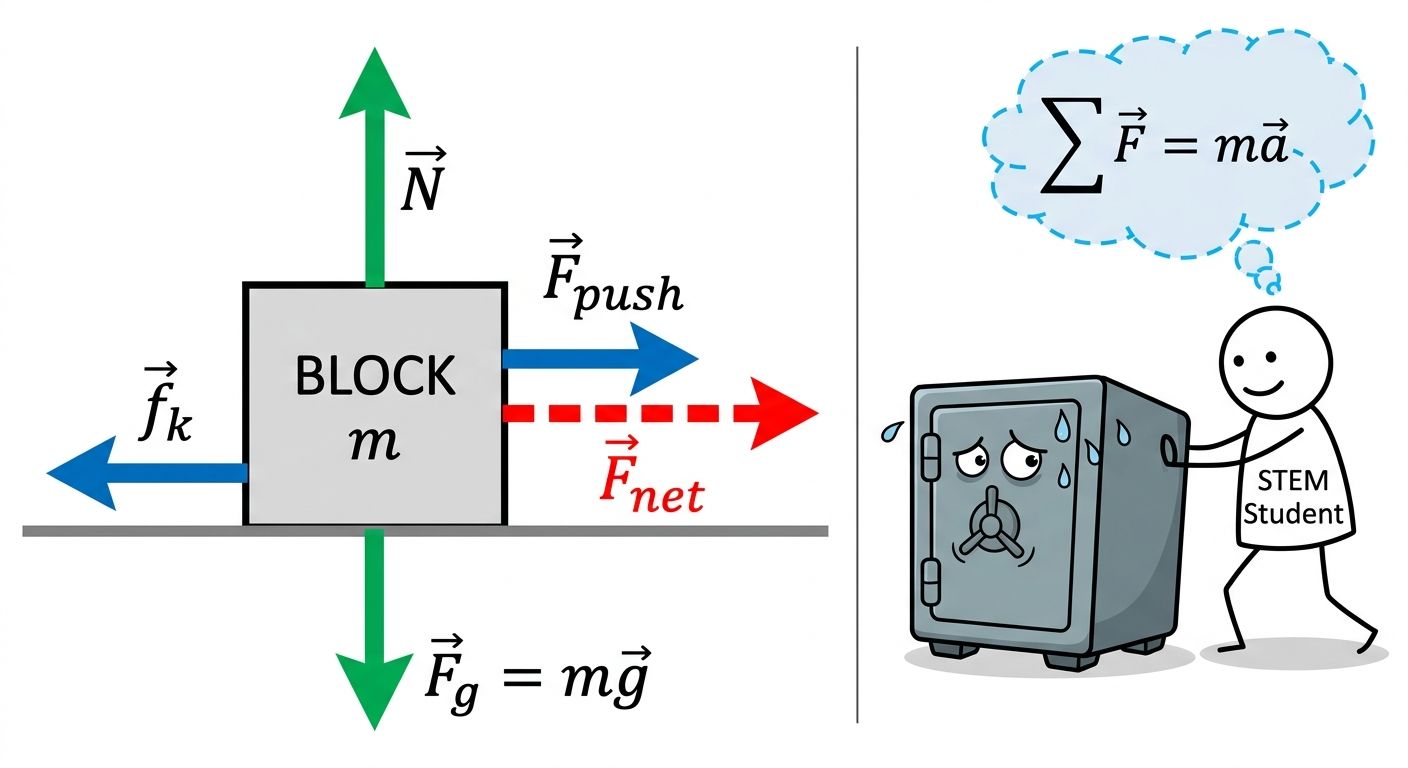
Free-body diagrams: A free-body diagram isolates one object and shows the forces acting on it. For a block resting on a horizontal surface, the important forces might be gravity and the normal force.
If the block is accelerating horizontally:
F=ma
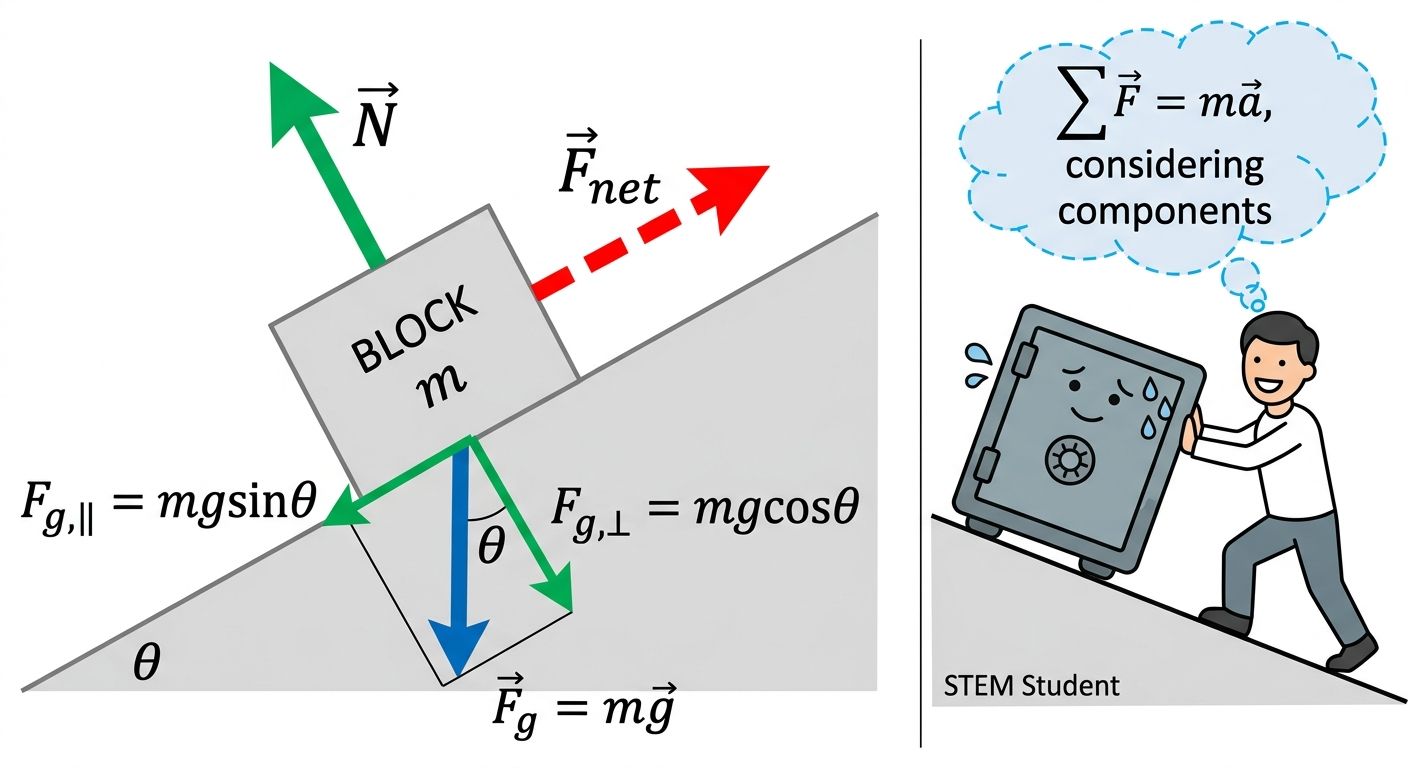
If the block is on an inclined plane, then you first need to separate the force of gravity into 2 vectors: Free body diagram of a block on an inclined plane
Newton's third law
Action and reaction
THIRD LAW OF MOTIONINTERACTION PAIRS
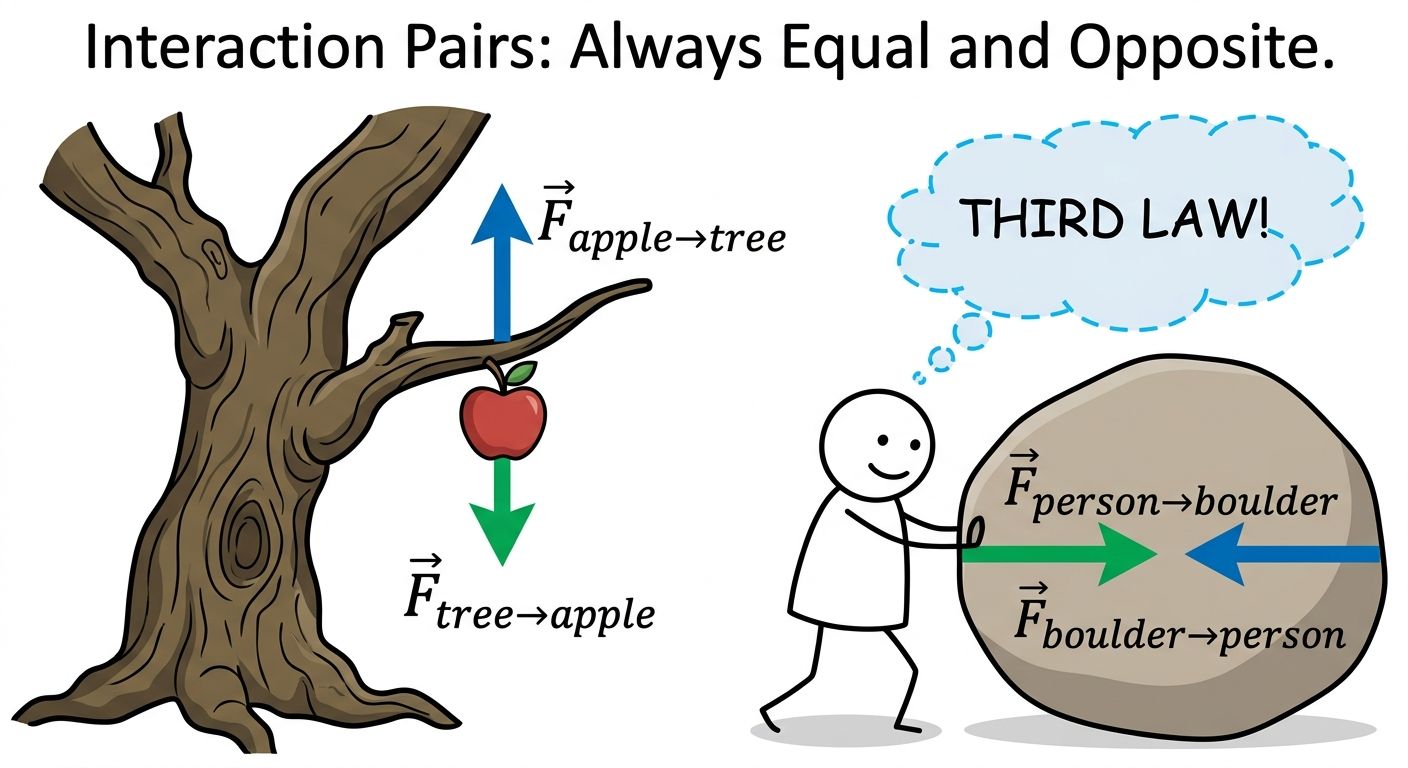
Forces arise from interactions. When object A exerts a force on object B,
object B simultaneously exerts an equal and opposite force on object A.
These two forces act on different objects. This is one of
the most common sources of confusion in mechanics. Action and reaction Demonstration — Two students on rolling chairs: Have two students face one another on low-friction chairs and push against
each other's hands. Ask which student experiences the larger force.
The forces in a Third-Law pair act on different objects, so they do not
cancel each other when analyzing the motion of one object.
Interactive activity — Identify the interaction: Give students situations such as a book resting on a table, a person
jumping, or a rocket launching. Ask them to identify the two objects
involved in each important interaction.
Friction and normal force
The forces we often overlook
FRICTIONNORMAL FORCE
Friction is an interaction between surfaces that opposes relative sliding.
A simple model for kinetic friction is:
The normal force is the force a surface exerts perpendicular to itself.
On a horizontal surface with no vertical acceleration:
But this relationship is not universally true. On an incline, for example,
the normal force is generally smaller than the object's weight.
Demonstration — Sliding objects: Slide the same object across wood, paper, fabric, and another smooth
surface. Ask students to rank the surfaces before testing them.
Mini-investigation: Have groups measure the angle at which an object begins to slide down an
inclined board. The experiment can be used to estimate the coefficient of
static friction.
Score 0
Shots 0
Destroyed 0
Draw physics
Max pull distance x0.36 m
Spring force F = kx0 N
Stored energy ½kx²0.0 J
Muzzle speed0.0 m/s
Momentum mv0.00 kg·m/s
Aim14° up, 0° R
Aim: move your mouse over the range.
Draw: hold Space or click and hold, then release to fire.
Pull distance is set by the slider below — the sling draws toward it while you hold.
Hooke's law gives the spring energy; heavier ammo launches slower but hits with more momentum.
Adjust your draw, pick your ammo, and aim. Hold SPACE (or click) to draw the sling — release to fire.
Ammunition
Side view — last shot's trajectoryNo shot recorded yet this turn
Work
How forces transfer energy
WORK
We have already seen that forces change an object's motion. But there is another useful question we can ask: how much does a force change the object's energy?
Work is the quantity we use to answer that question. In physics, work is not simply "effort." Instead, work measures how much energy a force transfers when it acts through a displacement.
Imagine pushing a box across the floor. If you push in the same direction that the box moves, you are transferring energy to the box. If friction acts in the opposite direction, friction removes energy from the box's motion. Work gives us a way to quantify both effects.
The mathematical definition is:
Using the definition of the dot product:
where is the angle between the force and the displacement.
The cosine tells us something physically important: only the component of the force in the direction of the displacement transfers energy through work.
If the force points in the same direction as the displacement, and , so the work is positive. The force transfers energy to the object.
If the force points opposite the displacement, and , so the work is negative. The force removes energy from the object.
If the force is perpendicular to the displacement, and , so the work is zero. That force does not transfer energy through work.
In the idealized physics sense, the answer is no. Your muscles may be using chemical energy and producing heat, but the backpack does not move. Since its displacement is zero, the mechanical work done on the backpack is zero.
This is a useful reminder that the physics definition of work is more specific than the everyday meaning of the word.
Demonstration — Carrying a weight: Have a student carry a weight horizontally at constant height. Ask the class whether the upward force from their arm does work on the weight.
The student's arm exerts an upward force, but the weight's displacement is horizontal. The two vectors are perpendicular, so:
The arm is certainly using energy, but the upward force from the arm does no mechanical work on the weight in the idealized model.
Work can also be negative. Friction, for example, generally acts opposite the displacement of a sliding object, so friction does negative work. This is one reason a sliding object eventually slows down: energy is being transferred out of its organized motion and into thermal energy.
This gives us a powerful connection:
Forces change motion, and work tells us how forces transfer energy.
Energy
A quantity that tracks the ability to cause change
ENERGYKINETICPOTENTIALCONSERVATION
Work gives us a way to talk about energy transfer. But what exactly is energy?
A useful starting point is to think of energy as a quantity that keeps track of the capacity of a system to produce physical change. An object can have energy because it is moving, because of where it is located in a force field, because it is compressed or stretched, because it is hot, or because of many other physical properties.
The important idea is that energy is not necessarily something we can see directly. Instead, we recognize it by what it can do. A moving ball can knock another ball out of the way. A raised weight can fall and accelerate. A compressed spring can launch an object. In each case, the system has energy that can be transferred into other forms.
This gives us a different way to analyze motion. Instead of asking: "What does every individual force do at every moment?" we can often ask: "Where is the energy initially, and where does it end up?"
There are many forms of energy, but we will begin with three especially important mechanical forms: kinetic energy, gravitational potential energy, and elastic potential energy.
Kinetic energy — energy of motion
A moving object has kinetic energy. The faster it moves, the more energy it has:
Why this expression?
We can connect it directly to the idea of work. Suppose we push an object with a constant net force acting along its direction of motion. Newton's second law tells us:
The work done on the object is:
Combining these gives:
Using the constant-acceleration relationship , we can rewrite this as:
This suggests that the natural quantity associated with motion is . We call it kinetic energy. Although we derived this for a constant force, the same relationship turns out to hold even when the force changes during the motion — you would just need calculus (an integral instead of a product) to compute the work in that more general case.
This is more than just a formula to memorize. It explains why a faster object is dramatically harder to stop. If the velocity doubles, the kinetic energy becomes four times as large:
That squared dependence is why a car traveling twice as fast requires much more energy to stop than one traveling at half the speed.
Gravitational potential energy — energy associated with height
Now consider a different situation. Hold a ball above the ground. It is not moving, so it has no kinetic energy. Yet something has clearly changed compared with holding the ball on the ground.
If you release it, gravity can accelerate the ball. The higher you lift it, the more energy gravity can transfer into its motion as it falls.
Near Earth's surface, we describe this stored energy as gravitational potential energy:
We can understand this expression by thinking about the work required to lift the object. Gravity pulls downward with force $mg$. If we lift an object at constant velocity through a height $h$ — so that none of our effort goes into speeding it up — our applied force must do exactly:
That energy does not simply disappear. It becomes energy associated with the object's position in Earth's gravitational field. We call that gravitational potential energy.
This also explains why the choice of zero height is arbitrary. What matters physically is the change in potential energy:
We can choose the floor to have , or the top of a table, or any other convenient reference height. Changing that choice changes the numerical value of , but not the physical predictions.
When an object falls, its gravitational potential energy decreases. Gravity does positive work, and the object's kinetic energy increases:
In an ideal situation, the amount lost from gravitational potential energy is exactly the amount gained as kinetic energy.
Elastic potential energy — energy stored by deformation
Gravity is not the only force that can store energy. A spring provides another example.
If you compress or stretch a spring, you have to exert a force to deform it. The farther you deform it, the stronger the spring pushes back:
The minus sign tells us that the spring force points opposite the displacement from equilibrium.
Notice something different from gravity: the spring force is not constant. When the spring is barely stretched, the force is small. As the spring is stretched farther, the force becomes larger.
Because the force changes as the spring is stretched, the work required to stretch it is not simply . The force needed to stretch the spring a distance grows linearly, from at the start up to at the end. Since it grows steadily, the average force during the stretch is just the halfway value, . Multiplying that average force by the distance gives the work done:
The squared dependence makes intuitive sense. Stretching a spring twice as far does not require twice as much energy; the spring is also exerting a larger force during the additional stretching.
Once released, the spring can transfer this stored energy into kinetic energy. A compressed spring in a toy, for example, can accelerate an object without requiring the object to be pushed continuously.
Different expressions, one underlying idea
At first, these equations may look unrelated:
But they all describe the same basic idea: different physical configurations can contain different amounts of energy.
Kinetic energy depends on motion. Gravitational potential energy depends on position in a gravitational field. Elastic potential energy depends on deformation.
The formulas are different because the physical mechanisms are different. There is no reason that the energy associated with moving an object should depend on the same variables in the same way as the energy associated with stretching a spring.
What connects them is that energy can be transferred from one form to another.
For example, when a ball falls:
When a moving object compresses a spring:
And when the spring launches the object:
Thinking in terms of energy lets us follow the transfer without necessarily calculating the detailed forces and acceleration at every instant. Work changes kinetic energy
We can now make a deeper connection between work and energy. The net work done on an object changes its kinetic energy:
This makes physical sense. Positive net work means that energy is transferred into the object's motion, so its kinetic energy increases. Negative net work means that energy is transferred out of its motion, so its kinetic energy decreases.
For example, when friction slows a sliding box, friction does negative work. The box loses kinetic energy. That energy has not vanished; it has primarily been transferred into thermal energy in the box and floor.
Work is therefore a mechanism for transferring energy, while energy is a quantity we can track before and after the transfer.
Conservation of mechanical energy
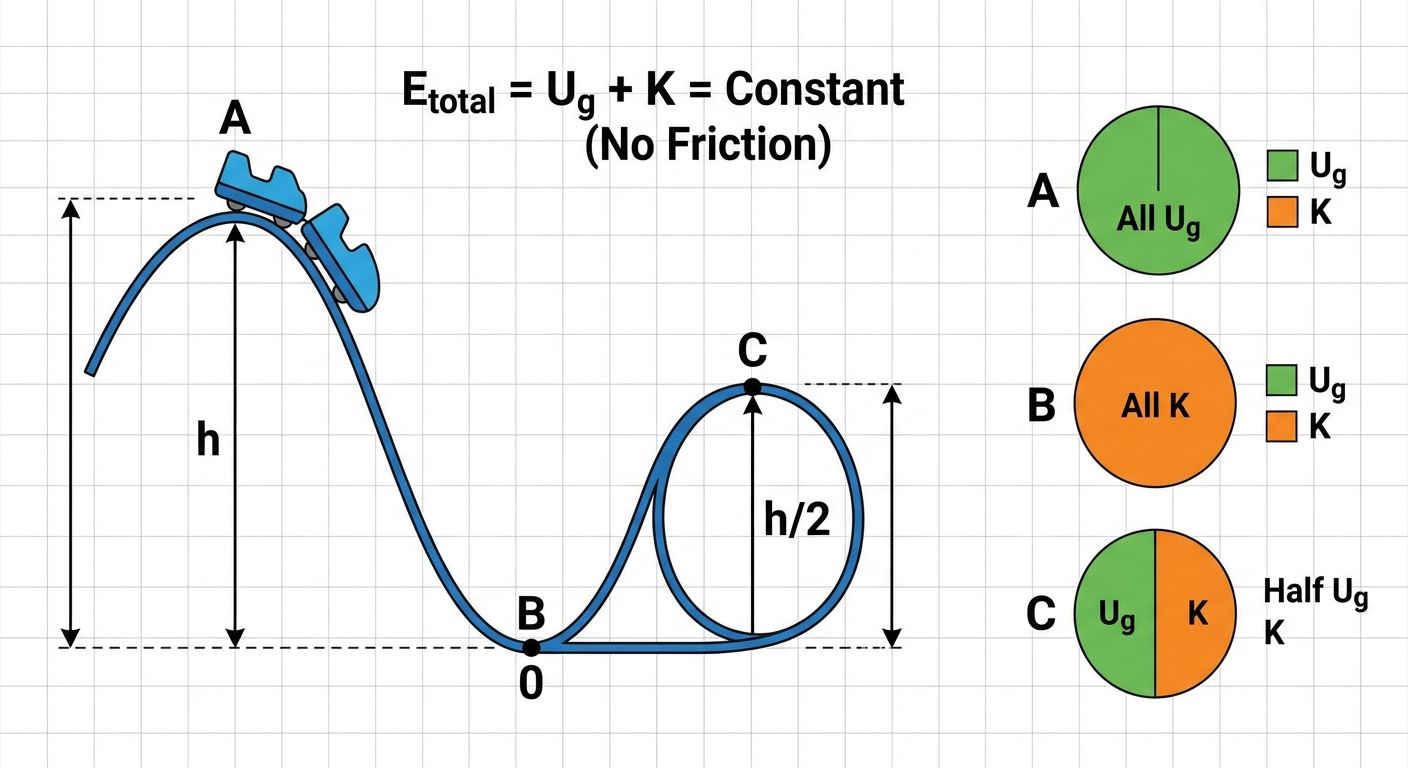
Suppose a ball is dropped from a height. At the beginning, most of its mechanical energy is gravitational potential energy. As it falls, that potential energy decreases while kinetic energy increases.
If there is no friction or air resistance, the total mechanical energy remains constant:
Or, more generally:
This does not mean that every individual type of energy stays constant. Kinetic energy can increase while potential energy decreases. What remains constant is the total energy of the isolated system.
If friction is present, mechanical energy is not conserved by itself because some mechanical energy is transferred into thermal energy. But if we include that thermal energy in the system, the total energy is still conserved.
Energy can be transferred between kinetic, gravitational potential, elastic potential, and thermal forms.
🎢 Classical Mechanics Rollercoaster Sandbox
Drag the 9 orange handles to engineer your path. Press Spacebar or click Launch Coaster to run.
Imagine a roller coaster starting from rest at the top of a hill. At the top, its kinetic energy is small while its gravitational potential energy is large. As it descends, gravitational potential energy is converted into kinetic energy.
Ignoring friction:
If the coaster starts from rest, $v_i=0$. We can then solve directly for its final speed.
Notice what we did not need to know: the exact shape of the track, the detailed acceleration at every point, or how long the coaster spends traveling downhill.
That is the major advantage of the energy approach. Newton's laws tell us how motion develops moment by moment; energy methods often let us compare the beginning and end of a process without calculating every detail in between.
This gives us two complementary ways to understand mechanics:
Forces and Newton's laws: What is causing the acceleration, and how does the motion change with time?
Energy: Where does the energy start, where does it end up, and how much energy is transferred?
Momentum
Motion that is hard to stop
MOMENTUMCOLLISIONS
Momentum combines an object's mass and velocity:
Because momentum is a vector, its direction matters.
Newton's Second Law can also be expressed in terms of momentum:
In an isolated system, total momentum is conserved:
Demonstration — Cart collision: Roll two carts toward one another and let them collide. Try different
masses and different initial velocities. Ask students to predict the
direction of the final motion.
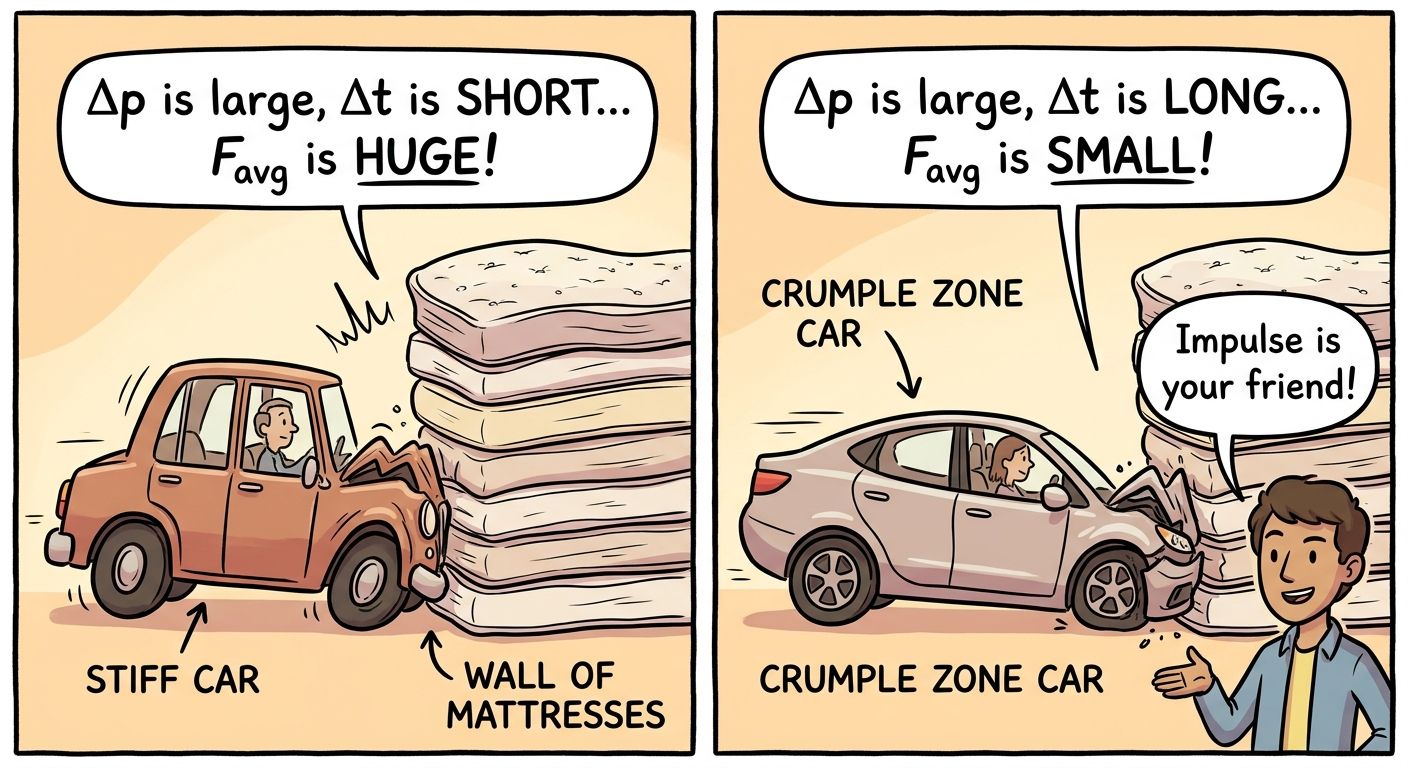
Real-world connection: Airbags and crumple zones increase the time over which a person's momentum changes. For approximately the same change in momentum, increasing the collision time reduces the average force.
Momentum
Putting it all together
The mechanics toolbox
PROBLEM SOLVINGMODELING
At this point we have several different tools for analyzing physical
situations.
Tool
Best for answering...
Kinematics
How does an object move?
Newton's Laws
What causes the acceleration?
Energy
How are motion and stored energy related?
Momentum
What happens during interactions and collisions?
Vectors
How do direction and components affect the answer?
A good mechanics problem-solving strategy is:
Identify the object or system.
Choose a coordinate system.
Identify what is known and what is unknown.
Draw a picture or diagram.
Identify relevant forces and interactions.
Choose an appropriate physical principle.
Write the equation symbolically before inserting numbers.
Check units and signs.
Ask whether the result makes physical sense.
Quiz//Question 1 OF 2
SCORE: 0
Q1. Drop a 1-kg ball from m high with an initial downward velocity of m/s. What is the speed of the ball in m/s just before hitting the ground? Solve using kinematics and acceleration.
Attempts registered: 0
Closing idea: Mechanics gives us a remarkably small set of principles that can explain
an enormous range of phenomena—from a falling apple to a spacecraft,
from a skateboard to a bridge, and from a collision to a roller coaster.